

Sunday, October 21, 2012
My new favorite thing!
Homeschooling will never be the same for us! I have discovered 360 Cities - a website that lets you access interactive 360º panorama images of user-submitted locations all over the world!! The interactive and spherical nature of these images really bring the locations to life and make it feel like you're standing there in person - a night and day difference from a 2D image. And the way the images are cataloged makes it incredibly easy to search for exactly what or where you're looking for, and you even have the option of clicking on a global map to explore images from any area of your choosing. The homeschool applications are unending! Are you studying China's great wall? Why not try standing on it?! Or might you be studying geology and cave formation? Have a look around one for yourself! You could visit the Louvre, see what it's like inside the engine room of a submarine, pay your respects at Ground Zero, go scuba diving in Egypt, stand on top of a volcano! The possibilities are truly endless!! And ds10 and I COULDN'T be having more fun. :) And isn't that how it's supposed to be?? :D


Monday, September 10, 2012
Online verb conjugator
For when there's ever any doubt... an online English verb conjugator (with options for French, Spanish, German as well).
Tuesday, September 4, 2012
Crash Course videos
 Add this to your toolbox: the Crash Course YouTube video series from Vlogbrothers. As of this posting they have made 64 videos, 32 each on World History and Biology. The videos are silly, exciting, very visual, interesting, and extremely engaging. Their geeky-silly style is akin to Bill Nye, Alton Brown, and Horrible Histories. And through this unique combination, the producers are incredibly able to cram you full of more information in 12 minutes than you've probably learned in your lifetime on a subject, and have you able to not only understand but retain it all. IMPORTANT NOTE: these videos are targeted toward older kids or young adults, and are sometimes quite blunt in their content matter, so you should preview each video before having your child watch it to determine the level of appropriateness. But don't worry - they're so fun, you won't mind one bit watching the video a second time with your child! ANOTHER IMPORTANT NOTE: these videos are also blatantly secular in their perspective, so often there will be philosophies in them that don't line up with the philosophies of most conservative homeschoolers. So again, preview each video first. However, I still maintain that these videos are useful, despite some of the content, due to their ability to engage and interest the learner and effectively give them a big-picture understanding of a topic before delving into the topic for further study. Please consider using them as a sort of preview of a subject, and following up each video with questions and conversation and further learning. And for parents of younger children, or children for whom the videos aren't appropriate, parents should also consider watching them for themselves, so that YOU can have a working understanding of the topic at hand before you delve into it. Or, you know, for pure entertainment, because these videos are CRAZY FUN!!
The list of videos to date, not in any particular order...
BIOLOGY
Your Immune System: Natural Born Killer
Evolution: It's a Thing
The Big Guns: Your Muscular System
Your Skeleton: It's ALIVE!
The Excretory System: From Your Heart to the Toilet
The Digestive System
Circulatory & Respiratory Systems
The Nervous System
Animal Behavior
Chordates
Complex Animals: Annelids & Arthropods
Simple Animals: Sponges, Jellies, & Octopuses
Comparative Anatomy: What Makes Us Animals
Taxonomy: Life's Filing System
Population Genetics: When Darwin
Met Mendel
Evolutionary Development: Chicken Teeth
Animal Development: We're Just Tubes
Speciation: Of Ligers & Men
Natural Selection
Meiosis: Where the Sex Starts
Mitosis: Splitting Up is Complicated
DNA, Hot Pockets, & The Longest Word Ever
DNA Structure and Replication
Heredity
Photosynthesis
ATP & Respiration
Plant Cells
In Da Club - Membranes & Transport
Eukaryopolis - The City of Animal
Cells
Biological Molecules - You Are What You Eat
Water - Liquid Awesome
That's Why Carbon Is A Tramp
HISTORY
Coal, Steam, and The Industrial Revolution
Latin American Revolutions
Haitian Revolutions
The French Revolution
Tea, Taxes, and The American Revolution
The Amazing Life and Strange Death of Captain Cook
The Seven Years War
The Spanish Empire, Silver, & Runaway Inflation
The Atlantic Slave Trade
The Columbian Exchange
The Renaissance: Was it a Thing?
International Commerce, Snorkeling Camels, and The Indian
Ocean Trade
Wait For It...The Mongols!
Mansa Musa and Islam in Africa
The Crusades - Pilgrimage or Holy War?
The Dark Ages...How Dark Were They, Really?
Islam, the Quran, and the Five Pillars All Without a
Flamewar
Fall of The Roman Empire ...in the
15th Century
Christianity from Judaism to the Constantine
The Roman Empire . Or Republic. Or...Which
Was It?
The Silk Road and Ancient Trade
Alexander the Great and the Situation ... the Great?
2,000 Years of Chinese History! The Mandate of Heaven and
Confucius: World History
Buddha and Ashoka
The Persians & Greeks
Ancient Egypt
The Agricultural Revolution
Columbus, de Gama, and Zheng He! 15th Century Mariners
Wednesday, August 29, 2012
Best online kids dictionaries
When we first started homeschooling, my little boy was in the 2nd grade, and at that time I voted WordCentral.com as the best online children's dictionary. I am now slightly altering my vote. I still hold that this online kids dictionary is the simplest to use and has the simplest, most concise all-in-one definitions for most words - which is GREAT for young elementary kids. But now my boy is in the 5th grade, and our dictionary needs have changed. My current favorite online kids dictionary is WordSmyth.com. This dictionary lets you chose from 3 different "comprehension" levels - beginner, intermediate, and advanced - beginner being usually as simple and concise as WordCentral, if not more, working up to advanced having a more expanded definition, usually with multiple possible meanings for a word, but always with definitions still easily understood by a child. Plus all levels of this dictionary include more information about the word than WC's entries do, more like you might find in a "grown-up" dictionary, which is great for the older ages. It's a little less streamlined to use, but still easy-peasy for my highly internet-capable 10 yr old. :)
Example definition for "comfort - (v)" from each:
WordCentral:
1 : to give strength and hope to : CHEER
2 : to ease the grief or trouble of : CONSOLE
WordSmyth - beginner:
to make someone feel less pain or worry.
WordSmyth - intermediate:
to give relief from a painful or difficult situation; soothe.
WordSmyth - advanced:
to give (someone) relief and strength in trouble or distress.
And there you have it.
Example definition for "comfort - (v)" from each:
WordCentral:
1 : to give strength and hope to : CHEER
2 : to ease the grief or trouble of : CONSOLE
WordSmyth - beginner:
to make someone feel less pain or worry.
WordSmyth - intermediate:
to give relief from a painful or difficult situation; soothe.
WordSmyth - advanced:
to give (someone) relief and strength in trouble or distress.
And there you have it.
Horrible Histories, and much MUCH more!
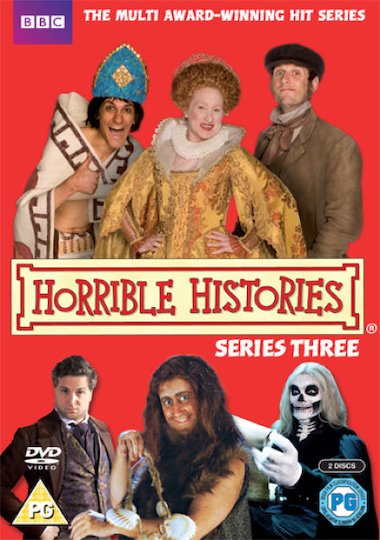 Getting your child interested and engaged in learning a subject makes teaching and learning tremendously more effective and enjoyable. The "Horrible Histories" videos that were put out in the UK are a brilliant and fantastically comedic way to do just that - especially for one the most notoriously "boring" subjects ever. But be warned! The humor is crude and bluntly honest, and though there's no foul language or such, parents may want to preview these videos first to determine the level or appropriateness for their child (I recommend pre-teen and up). That being said, I reiterate, THEY ARE HILARIOUS!!! And full of interesting tidbits you never would have imagined. Here is a list of all the videos that were made, and they can all be found through a simple YouTube search such as this one.
There is also the related book series, which is equally comical, gruesome, and intellectually engaging. My 10 year old boy is eating them up like candy! Here is a complete list of the Horrible Histories books, which are available for purchase in many different combinations and formats.
 And THEN there is the Horrible Science book series, which ds10 finds absolutely amazing!
And THEN there is the Murderous Maths book series, which ds10 finds utterly astounding!
And THEN there is the Horrible Geography book series, which ds10 finds incredibly intriguing!
And America's Funny But True History series, which we haven't read yet.
Oh, and we musn't forget the Boring Bible series - which makes learning about God's word anything BUT! :)
...and several other minor book spinoffs that I don't have room to list.
There is also a Horrible Histories website, a Murderous Maths website, and a Horrible Science website, each with some fun games and bits of trivia on it, but IMHO they are utterly lacking compared to the books and videos, and not worth looking at except to preview the kind of material you are likely to find in the books.
Magic Tree House books
The Magic Tree House books need little introduction - they are a well-known series of books telling the adventures of a brother and sister who time travel through the use of a magic tree house and get to participate in famous historical events. For your (and my) convenience, below is a sorted list of the books chronologically or by topic, so you can easily find a book to tie in to your lessons.
| 1 | Dinosaurs Before Dark (UK title: Valley of the Dinosaurs ) | The Mystery of the Tree House #1 | BC 10000 | Jack and Annie discover the tree house and, using the magical books there, they travel back to the Late Cretaceous period (65 million years ago) where they meet a Pteranodon that saves them from a T-rex. Jack finds a gold medallion with the letter "M" on it. |
| 7 | Sunset of the Sabertooth (UK title: Mammoth to the Rescue ) | The Mystery of the Magic Spell #3 | BC 10000 | In the last Ice Age, Jack and Annie encounter Cro-Magnons, wooly mammoths, and a saber-toothed cat while looking for the third object to help Morgan le Fay. |
| 3 | Mummies in the Morning (UK title: Secret of the Pyramid ) | The Mystery of the Tree House #3 | BC 1500 | In Ancient Egypt, Jack and Annie help Queen Hutepi find her missing Book of the Dead. |
| 16 | Hour of the Olympics (UK title: Olympic Challenge! ) | The Mystery of the Lost Stories #4 | BC 750 | Jack and Annie travel to Ancient Greece and see the first Olympic games. |
| 13 | Vacation Under The Volcano (UK title: Racing with Gladiators ) | The Mystery of the Lost Stories #1 | AD 80 | Jack and Annie travel to Pompeii on the eve of the eruption of Mt Vesuvius. |
| 34 | Season of the Sandstorms | Using Magic Wisely #2 | AD 750 | Jack and Annie must help the caliph of ancient Baghdad spread wisdom to the world. |
| 15 | Viking Ships at Sunrise (UK title: Voyage of the Vikings ) | The Mystery of the Lost Stories #3 | AD 800 | In medieval Ireland, Jack and Annie encounter Vikings. |
| 2 | The Knight at Dawn (UK title: Castle of Mystery ) | The Mystery of the Tree House #2 | AD 1000 | In England during the Middle Ages, Jack and Annie explore a castle and meet a brave knight. |
| 37 | Dragon of the Red Dawn | Happiness #1 | AD 1200 | Jack and Annie travel back in the Magic Tree House to feudal Japan to find the first of four secrets of happiness for Merlin the magician because Morgan has noticed that he does not feel well, does not eat or sleep, and is tired. To do this, they must spend the day with famous Japanese haiku poet Matsuo Basho. |
| 38 | Monday with a Mad Genius | Happiness #2 | AD 1500 | Jack and Annie travel back in the Magic Tree House to Florence, Italy, to find the second of four secrets of happiness. To do this, they must help Leonardo da Vinci all day, "morning, noon, and afternoon, till the night bird sings its song." |
| 25 | Stage Fright on a Summer Night | Type of Magic #1 | AD 1585 | In Elizabethan England, Jack and Annie meet William Shakespeare. |
| 27 | Thanksgiving on Thursday | Type of Magic #3 | AD 1621 | In Plymouth in 1621, Jack and Annie share the first Thanksgiving with the Pilgrims and Wampanoag Indians. |
| 4 | Pirates Past Noon (UK title: Pirates' Treasure! ) | The Mystery of the Tree House #4 | AD 1650 | Jack and Annie encounter some pirates in the Caribbean Sea and meet Morgan le Fay. |
| 33 | Carnival at Candlelight | Using Magic Wisely #1 | AD 1700 | Jack and Annie must go and save Venice, Italy from a flood disaster, but Merlin's instructions are confusing. The next four books are part of an arc where Jack and Annie complete missions to prove to Merlin that they can use magic wisely. |
| 41 | Moonlight on the Magic Flute | Inspiring #1 | AD 1765 | Jack and Annie head to 18th-century Austria, where they must find and help a musician by the name of Mozart. Decked out in the craziest outfits they’ve ever worn—including a wig for Jack and a giant hoopskirt for Annie, the two siblings search an entire palace to no avail. Their hunt is further hampered by the appearance of a mischievous little boy who is determined to follow them everywhere. But when the boy lets the animals out of the palace zoo, Jack and Annie have to use the only magic at their disposal to save themselves and the naughty little boy. |
| 22 | Revolutionary War on Wednesday | Morgan's Library #2 | AD 1775 | Jack and Annie cross the Delaware river with George Washington. |
| 18 | Buffalo Before Breakfast | The Mystery of the Enchanted Dog #2 | AD 1800 | In the American Old West, Jack and Annie encounter a Lakota boy on the Great Plains. |
| 44 | A Ghost Tale for Christmas Time | Inspiring #4 | AD 1840 | The kids are whisked back to Victorian England to help famed author Charles Dickens. The kids know Charles had everything he wants. Will the kids find the thing Charles wants? The kids are thrown in jail, only to be saved by Charles Dickens! To find Charles' secret, they will need help from three ghosts and get to know Charles very, very, well. |
| 10 | Ghost Town at Sundown (UK title: A Wild West Ride ) | The Mystery of the Ancient Riddles #2 | AD 1850 | Set in the American Wild West, where Jack and Annie meet a cowboy named Slim. |
| 21 | Civil War on Sunday | Morgan's Library #1 | AD 1855 | In the American Civil War, Jack and Annie encounter Clara Barton. |
| 47 | Abe Lincoln At Last | Penny's Spell #3 | AD 1855 |
|
| 23 | Twister on Tuesday | Morgan's Library #3 | AD 1870 | In the 1870s, Jack and Annie encounter pioneer settlement of the Midwestern prairie. They have to save a teacher and some kids before they are hit by a Tornado. |
| 39 | Dark Day in the Deep Sea | Happiness #3 | AD 1870 | The magic tree house takes Jack and Annie to a deserted island, in the 1870s, looking for another secret of happiness. They get rescued by scientists on a ship, in the Atlantic Ocean, and end up helping the scientists, who are looking for a sea monster. Will they be able to help the scientist and find the secret of happiness? This book is 128 pages long, making it the longest book in the series. |
| 35 | Night of the New Magicians | Using Magic Wisely #3 | AD 1889 | Jack and Annie travel to the Paris Exposition Universelle of 1889 in the Magic Tree House. They have to save four new magicians (Alexander Graham Bell, Louis Pasteur, Thomas Edison, and Gustave Eiffel), before an evil sorcerer kidnaps them and steals the secrets of their magic. As it turns out, there is no evil sorcerer and the only one that shows up is Merlin himself who had wanted to meet the four. |
| 43 | Leprechaun in Late Winter | Inspiring #3 | AD 1900 | The kids meet a leprechaun girl in their third mission to put "artists" on the right path. The leprechaun girl grows up to be Lady Gregory, a famous legendteller of the Irish lore. Can the kids save Gregory and put the third artist on the right path? This is the first time that something that one of the kids has written has been used to travel through time: the kids time travel by wishing using Jack's notes on where they are traveling to. |
| 24 | Earthquake in the Early Morning | Morgan's Library #4 | AD 1906 | In 1906, Jack and Annie experience the San Francisco earthquake. The two are able to use what they find to inspire King Arthur to battle Mordred, although in a later book its shown that he wins without dying in these stories. |
| 17 | Tonight on the Titanic | The Mystery of the Enchanted Dog #1 | AD 1912 | Jack and Annie travel back to 1912 and are on the RMS Titanic during her fateful voyage. In this arc the two are assisted by a dog named Teddy that they must find gifts to free. |
| 36 | Blizzard of the Blue Moon | Using Magic Wisely #4 | AD 1938 | Jack and Annie travel in the Magic Tree House to the New York City of the Great Depression in 1938. They must help a unicorn under a spell. However, two evil sorcerers in training, Balor and Grinda, are up to the same challenge. In this book, Jack and Annie are given the power to make magic on their own via a magic wand. |
| 42 | A Good Night for Ghosts | Inspiring #2 | AD 1940 | Jack and Annie are on their second mission to find—and inspire—artists to bring happiness to millions. After traveling to New Orleans, Jack and Annie come head to head with some real ghosts, as well as discover the world of jazz when they meet a young Louis Armstrong. |
| 11 | Lions at Lunchtime (UK title: Lions on the Loose ) | The Mystery of the Ancient Riddles #3 | Africa | Set on the African savannah with lions. |
| 46 | Dogs in the Dead of Night | Penny's Spell #2 | Alps | Jack and his sister Annie travel to Swiss Alps to get the second magical object to break the beloved baby penguin, Penny. They face a dog rescue and many other adventures. |
| 40 | Eve of the Emperor Penguin | Happiness #4 | Antarctica | Jack and Annie go to Antarctica to try to find their last secret of happiness, but they only find penguins. Only the penguins have the answer to this question. This is the only book where it is specifically stated that Jack and Annie did not travel through time. They also use the wand to make magic twice: once to find the penguins and a second time to teleport to Mount Erebus, the only time they use its power twice. |
| 5 | Night of the Ninjas | The Mystery of the Magic Spell #1 | Asia | In ancient Japan, Jack and Annie encounter ninjas and samurai. |
| 14 | Day of the Dragon King (UK title: Palace of the Dragon King ) | The Mystery of the Lost Stories #2 | Asia | Jack and Annie travel to China as it was 2,000 years in their past. The Dragon King is also known as Emperor Qin. |
| 20 | Dingoes at Dinnertime | The Mystery of the Enchanted Dog #4 | Australia | Set in ancient Australia. Jack and Annie receive the final gift and return home where Morgan removes the spell on the dog who is revealed to be a boy named Teddy who is a young magician who trapped himself under a spell. This story introduces the character of Teddy who becomes a friend and ally to Jack and Annie over later stories. |
| 28 | High Tide in Hawaii | Type of Magic #4 | Hawaii | Jack and Annie travel to the Hawaii of the past and almost get caught in a tsunami. They also make two friends who share an adventure with them. |
| 19 | Tigers at Twilight | The Mystery of the Enchanted Dog #3 | India | Jack and Annie explore the Indian jungles of the past. |
| 45 | A Crazy Day with Cobras | Penny's Spell #1 | India | The kids travel to an Indian desert because Penny, Merlin's beloved penguin (from Eve of the Emperor Penguin ), has been put under a terrible spell. Jack and Annie have to escape a swarm of king cobras and defeat the infamous All-Power Great Mogul. To start their quest, Jack and Annie must find a giant ruby emerald to find the first piece of breaking Penny's spell. |
| 12 | Polar Bears Past Bedtime (UK title: Icy Escape ) | The Mystery of the Ancient Riddles #4 | North Pole | Set in the North Pole. |
| 9 | Dolphins at Daybreak (UK title: Diving with Dolphins ) | The Mystery of the Ancient Riddles #1 | Pacific Ocean | Set in the Pacific Ocean with bottlenose dolphins. |
| 6 | Afternoon on the Amazon (UK title: Adventure on the Amazon ) | The Mystery of the Magic Spell #2 | South America | Jack and Annie search the Amazon rainforest for Morgan le Fay. |
| 26 | Good Morning Gorillas | Type of Magic #2 | South America | In the Congo rain forest, Jack and Annie encounter gorillas. |
| 8 | Midnight on the Moon (UK title: Moon Mission ) | The Mystery of the Magic Spell #4 | Space | Forty years into their future (2036), Jack and Annie travel to the moon to look for the fourth object needed to help Morgan le Fay. In the end Jack and Annie learn that their mouse companion Peanut was a transformed Morgan Le Fay who was trapped under a spell. Jack and Annie break the spell and return her to human form before returning home. |
Educational graphic novels for kids
Rosen Publishing has a huge series of Graphic Nonfiction books covering many historical, scientific, and educational topics, each in "graphic novel" story format. This is a GREAT way to get your visually-oriented or easily-bored readers thoroughly engaged in a topic. They're not to be used as primary source material, but as a supplement, but a great one! Book sets in this series include:
- Grammar Ray: A Graphic Guide to Grammar – grade 2-5: Adjectives, Adverbs, Nouns & Pronouns, Prepositions, Punctuation & Sentences, Verbs
- Graphic Battles of the Civil War – grade 4-5:
- Graphic Battles of World War II – grade 5: D-Day,
- Graphic Dinosaurs – grade
- Graphic Discoveries – grade 5: Ancient Treasures, Fantastic Fossils, Incredible Space Missions, Medical Breakthroughs, Spectacular Shipwrecks, The History of Flight
- Graphic Forensic Science – grade 5: 6 books, each profiling one aspect of forensic science in story format
- Graphic Mythology – grade 4-5: 6 books exploring the mythology of ancient cultures
- Graphic Natural Disasters – grade 5: 6 books
- Graphic Nonfiction Biographies – grade 4-5: Abraham Lincoln, Christopher Columbus, George Washington, Harriet Tubman, Hernan Cortes, Sitting Bull, Alexander the Great, Cleopatra, Elizabeth I, Julius Ceasar, Richard the Lionheart, Sartacus, Bob Marley, Martin Luther King Jr., Muhammad Ali, Nelson Mandela, Rosa Parks
- Jr. Graphic American Legends – grade 2-3: Casey Jones, Jim Bowie, Paul Bunyan, Davy Crockett, Johnny Appleseed, Daniel Boone
- Jr. Graphic Biographies – grade 2-3: Sitting Bull, Hernan Cortes, Harriet Tubman, George Washington, Christopher Columbus, Abraham Lincoln
- Jr. Graphic Colonial
- Jr. Graphic Founding Fathers – grade 2-3: , each profiling
one of
- Jr. Graphic Mythologies – 5 books, grade 2-3, exploring the mythology of ancient cultures
- Superheroes on a Medical Mission – 12 books, grade 5-8, exploring medical conditions

Tuesday, November 22, 2011
Random memory trick
I needed a memory trick to help ds10 remember the number of feet in a mile (which I myself have never been able to remember either). A simple Google search quickly got me exactly what I was looking for. But I thought it was so creative and clever, I just had to share with you all!
Quoted from: http://www.frugal-cafe.com/homeschooling/articles/math-memory-tricks1.html
Quoted from: http://www.frugal-cafe.com/homeschooling/articles/math-memory-tricks1.html
Here is a way to remember how many feet are in a mile. Say to yourself the phrase, "five tomatoes." There are 5,280 feet in a mile, and those numbers (5 - 2 - 8 - 0) sound very similarly to "five tomatoes." See the table below for a visual explanation.
FIVE
|
TO
|
MAT
|
OES
|
5
|
2
|
8
|
0
|
Friday, October 14, 2011
Multiplication MadGabs
At this point, ds9 has memorized the majority of his multiplication tables fairly well. But there are several problems that he repeatedly gets stuck on, and they're the same ones than many other people get stuck on as well. The dreaded 6's, 7's, and 8's. I spent some time this evening trying to find effective chants, rhymes, tricks, or songs to help him thoroughly master these multiplication problems on the WWW. But for one reason or another, ds9 were both unsatisfied with all the options that we found. (Note that he can count up by these numbers just fine, he just needed help memorizing the actual problems.) So, I started playing around with some rhymes of my own. One thing led to another, and before I knew it, ds9 & I had written a series of "MadGab"s (after the board game) for all of his troublesome problems. AND THEY ARE...
4 x 4 = 16
Fort eyes for his hicks team.
6 x 3 = 18
Seek sty miss free his ate team.
7 x 6 = 42Save a time sick, she’s for tea, too.
Save van thyme sick seas fort heat hue.
7 x 7 = 49
Say vent I’m save hen is far teen hind.
8 x 4 = 32
Hay times fort his there’d eat who.
8 x 7 = 56
Hate Heinz heaven knees fit tease hicks.
8 x 8
Ate I'm say tis hick Steve oar.
Friday, October 7, 2011
Interactive History Adventure books
I discovered these books at my local library, and I'm so glad I did! They're a series of 35 "Interactive History Adventure" books (think "Choose Your Own Adventure") by Caps tone Publishers. Most of the history topics covered pertain to American history, but there are quite a few from early World history as well. What a perfect way to get a child excite
 d about learning history! And I can think of no better way to learn history than to experience it firsthand and discover for yourself what the consequences of various choices are - after all, isn't that why we study history in the first place? Ds9 loves them, and I highly recommend them! Note: I would estimate that these books would hold the interest of little boys and girls anywhere from 8-13.
UPDATE 8/30/2012:
There are now (39) books in this list, not counting the survival series. Below are corrected, updated links. There are 8 "Era" adventure books are for grades 3-7, covering the ancient cultures of China, Egypt, Greece, Rome, colonial America, the Great Depression, and the Middle ages. There are 26 "History" adventure books, also for grades 3-7, covering topics mainly having to do with battles, wars, exploration, immigration. There are 5 books in the "Warriors" series, same grade level: Gladiator, Knight, Ninja, Samurai, Viking. There are also 8 books in the "Survival" series (think "Bear Grylls for kids"). :)
 tone Publishers. Most of the history topics covered pertain to American history, but there are quite a few from early World history as well. What a perfect way to get a child excite
 d about learning history! And I can think of no better way to learn history than to experience it firsthand and discover for yourself what the consequences of various choices are - after all, isn't that why we study history in the first place? Ds9 loves them, and I highly recommend them! Note: I would estimate that these books would hold the interest of little boys and girls anywhere from 8-13.
UPDATE 8/30/2012:
There are now (39) books in this list, not counting the survival series. Below are corrected, updated links. There are 8 "Era" adventure books are for grades 3-7, covering the ancient cultures of China, Egypt, Greece, Rome, colonial America, the Great Depression, and the Middle ages. There are 26 "History" adventure books, also for grades 3-7, covering topics mainly having to do with battles, wars, exploration, immigration. There are 5 books in the "Warriors" series, same grade level: Gladiator, Knight, Ninja, Samurai, Viking. There are also 8 books in the "Survival" series (think "Bear Grylls for kids"). :)
Sunday, September 11, 2011
Age of Empires
My husband bought the first Age of Empires game for my then 6 or 7 yr old son a few years ago. I trusted his word that it was an appropriate game, noted that it seemed to be a typical strategy-type RPG (think Kingdom Hearts or Final Fantasy), approved that it seemed to have a historical framework, but didn't give it much thought beyond that. My son proceeded to thoroughly play the game, and a few of of its successors or expansion packs, inside outside and backward for the next year or two, still without me giving the game much thought except in the rationing of his computer time (as I typically have no personal interest in RPGs).
Then we began some hard-core history lessons. And THAT'S when I realized what a TREASURE there was in this game! Lesson after lesson after lesson, I would introduce a new civilization, notable figure, vocabulary term, historical event, or cultural concept to my son, and almost every time I found out he was already familiar with the subject from the "firsthand" history lessons he'd experienced in his game. Years later, I'm still finding that there almost never a bit of history that I have to present to him that he doesn't already have some sort of basic understanding of - from cultural relationships and wars to climate, economics, and religion - this brilliantly written series of games covers it all! Every major event, every major historical figure, and every major civilization (and many many minor ones) are ALL covered to one degree or another. Of course, the lessons we do in our homeschooling are much more in depth, and as his teacher I am able to fill in all the gaps for him. But never am I presenting him with a completely foreign subject from scratch which he then has to not only retain but understand. The groundwork has already been laid for me! And I LOVE that!
I'll never forget the time that he made a trebuchet for us out of his K'Nex, and proudly presented it to us, through no teaching on our parts. When we asked him what it was, he eagerly announced that it was a "Tree Bucket". (There's not much audio in the game, and that was his best prounciation of the awkwardly-spelled French word, hehe.)
I can't tell you much more about the game, because I have not played it myself. But from talking with my husband and son, and watching a few tutorial videos online, I CAN tell you that it is MOSTLY exploration, strategy, and character interaction, low-definition army battle scenes with only tiny specks of blood stains as gore, and occasional high-def battle scenes with really no gore at all.
Lastly, I just want to reiterated how much my son LOVES THIS GAME! And the game has given him a passion an intrigue for history as well, making our lessons all the more exciting. I can't imagine how I would have muddled through homeschool history lessons without it.
Here are the games that I know of, and some of the civilizations that kids can play as or learn about in the course of the game.
Age of Empires I:
(pre-Rome civilizations)
Mycenaeans, Greeks, Minoans, Phoenicians, Egyptians, Assyrians, Sumerians, Babylonians, Persians, Hittites, Shang, Choson, Yamato
Age of Empires - The Rise of Rome:
(Alexander through the fall of Rome)
Romans, Palmyrans, Macedonians, Carthaginians
Age of Empires II - The Age of Kings:
(the Middle Ages)
Britons, Byzantines, Celts, Goths, Teutons, Franks, Mongols, Chinese, Japanese, Persians, Saracens, Turks and the Vikings
Age of Empires II - The Conquerors:
(expansion pack)
Aztecs, Mayans, Spanish, Koreans, and Huns
Age of Empires III:
(age of colonial empires)
Spanish, British, French, Portuguese, Dutch, Russian, German, Ottoman, Pirates, Circle of Ossus, Native Americans (12 tribes, including Inca and Maya)
Age of Empires III - The War Chiefs:
(expansion pack with mainly North American history)
Iroquois, Sioux, Aztec
Age of Empires III - The Asian Dynasties:
(expansion pack with mainly, you guessed it, Asian history)
Chinese, Japanese, Indians, Sufis, Shaolin, Zen, Udasi, Bhakti, Jesuits
Age of Empires - Online:
Greeks, Egyptians, Celtic, Persian
Then we began some hard-core history lessons. And THAT'S when I realized what a TREASURE there was in this game! Lesson after lesson after lesson, I would introduce a new civilization, notable figure, vocabulary term, historical event, or cultural concept to my son, and almost every time I found out he was already familiar with the subject from the "firsthand" history lessons he'd experienced in his game. Years later, I'm still finding that there almost never a bit of history that I have to present to him that he doesn't already have some sort of basic understanding of - from cultural relationships and wars to climate, economics, and religion - this brilliantly written series of games covers it all! Every major event, every major historical figure, and every major civilization (and many many minor ones) are ALL covered to one degree or another. Of course, the lessons we do in our homeschooling are much more in depth, and as his teacher I am able to fill in all the gaps for him. But never am I presenting him with a completely foreign subject from scratch which he then has to not only retain but understand. The groundwork has already been laid for me! And I LOVE that!
I'll never forget the time that he made a trebuchet for us out of his K'Nex, and proudly presented it to us, through no teaching on our parts. When we asked him what it was, he eagerly announced that it was a "Tree Bucket". (There's not much audio in the game, and that was his best prounciation of the awkwardly-spelled French word, hehe.)
I can't tell you much more about the game, because I have not played it myself. But from talking with my husband and son, and watching a few tutorial videos online, I CAN tell you that it is MOSTLY exploration, strategy, and character interaction, low-definition army battle scenes with only tiny specks of blood stains as gore, and occasional high-def battle scenes with really no gore at all.
Lastly, I just want to reiterated how much my son LOVES THIS GAME! And the game has given him a passion an intrigue for history as well, making our lessons all the more exciting. I can't imagine how I would have muddled through homeschool history lessons without it.
Here are the games that I know of, and some of the civilizations that kids can play as or learn about in the course of the game.
Age of Empires I:
(pre-Rome civilizations)
Mycenaeans, Greeks, Minoans, Phoenicians, Egyptians, Assyrians, Sumerians, Babylonians, Persians, Hittites, Shang, Choson, Yamato
Age of Empires - The Rise of Rome:
(Alexander through the fall of Rome)
Romans, Palmyrans, Macedonians, Carthaginians
Age of Empires II - The Age of Kings:
(the Middle Ages)
Britons, Byzantines, Celts, Goths, Teutons, Franks, Mongols, Chinese, Japanese, Persians, Saracens, Turks and the Vikings
Age of Empires II - The Conquerors:
(expansion pack)
Aztecs, Mayans, Spanish, Koreans, and Huns
Age of Empires III:
(age of colonial empires)
Spanish, British, French, Portuguese, Dutch, Russian, German, Ottoman, Pirates, Circle of Ossus, Native Americans (12 tribes, including Inca and Maya)
Age of Empires III - The War Chiefs:
(expansion pack with mainly North American history)
Iroquois, Sioux, Aztec
Age of Empires III - The Asian Dynasties:
(expansion pack with mainly, you guessed it, Asian history)
Chinese, Japanese, Indians, Sufis, Shaolin, Zen, Udasi, Bhakti, Jesuits
Age of Empires - Online:
Greeks, Egyptians, Celtic, Persian
Tuesday, September 6, 2011
Intelligent Design science videos
I love incorporating movies, documentaries, and fun educational videos into our homeschool lessons whenever possible. And usually there are great videos to be found on nearly any subject we teach. However, when it comes to the biology section of our science lessons, I've run into a limitation with just about all the science videos I've found. They all seem to be presented from a strong evolutionary viewpoint, some almost to the the point of feeling like a platform for evolution in the disguise of a children's video. This is a problem for us, since we teach "Intelligent Design" (a.k.a. creation science), and address evolution as only a theory, and a weak one at best. So in the past I've just left video watching OUT of our biology lessons. But what fun is that for the kids? So yesterday I went searching, and found a treasure trove of ID videos on the Answers in Genesis for kids website. They're not strictly biology, but they're mostly biology, and the rest can be shelved for later. And some of them may be a bit on the cheesy side, but what kids video isn't (hehe), and after all, they're better than nothing, so I'm happy. :)
Thursday, March 17, 2011
Recent finds
Best online dictionary for kids: WordCentral.com
Best all-inclusive Social Studies curriculum: Heritage Studies by BJU Press. This curriculum includes Geography, Economics, Government, American History, World History, and Culture, so you don't have to worry about finding a separate curriculum for each. Available for grades 1-12.
Best states & capitals games online:
Best all-inclusive Social Studies curriculum: Heritage Studies by BJU Press. This curriculum includes Geography, Economics, Government, American History, World History, and Culture, so you don't have to worry about finding a separate curriculum for each. Available for grades 1-12.
Best states & capitals games online:
- SheppardSoftware.com - a range of difficulty levels and different styles of games. The most challenging states/capitals games here challenges you to choose the correct capital for a given state from the entire list of 50 displayed capitals - surprisingly very difficult. There are also many more geography-related games and resources on this website.
- YourChildLearns.com - this states/capitals game gives you a capital which you must drag onto the correct unlabeled state - very challenging. This website also has many other geography puzzles and games, which can be found here.
- KidsGeo.com - this is a nice multiple choice option which shows you a given state, and asks you to choose the correct capital from 4 options. Again, many more geography games and resources are on this website, and worth looking at.
Standardized Tests
If you've opted to give your homeschooler a yearly standardized achievement test to fulfill the government's requirement (as opposed to having your work reviewed monthly by a certified teacher), here are your most widely used options:
(*optional)
These are just the basic considerations. There are other considerations out there, and a wide range of opinions about tests, if you go searching for them. But it helps to be able to see the "in a nutshell" info side by side, so there you have it. There are also other testing options, but they may or may not be approved for use in your state. These three are the most widely recognized, from what I've found.
The Cat5 test can be purchased here, and the ITBS and SAT tests can be purchased here.
| Test | Subjects tested | Total test time (complete battery) | Test difficulty | Report analysis | Cost | Degree required to test |
| CAT/5® | reading, language, spelling, math, science* and social studies* | 2.5-3.5 hrs | Easy | Simple | $40 | No |
| ITBS | reading, language (includes spelling), math, science*, social studies*, sources of information*, cognitive abilities* | 3-5 hrs | More difficult | More detailed | $50-70 | BA/BS, OR teaching certificate, OR teach or taught in public school. |
| SAT | reading, math, language, spelling, science*, social studies*, listening*, thinking* | 3-6 hrs | Most difficult | Very detailed | $50-70, +$20 app fee | Bachelor's, OR teaching certificate, OR teach or taught in public school. |
These are just the basic considerations. There are other considerations out there, and a wide range of opinions about tests, if you go searching for them. But it helps to be able to see the "in a nutshell" info side by side, so there you have it. There are also other testing options, but they may or may not be approved for use in your state. These three are the most widely recognized, from what I've found.
The Cat5 test can be purchased here, and the ITBS and SAT tests can be purchased here.
Thursday, March 10, 2011
Bill Nye resources
I don't need to tell you how useful Bill Nye's videos are in helping our kids get excited about science, and retain what they learn. The man needs no introduction. Instead, I'll just share with you a few useful links.
Enjoy!
- A complete categorized list of all his episodes, including full descriptions of each episode.
- Links to free web-hosted videos of every episode - of which Megavideo has the best quality and track record. (Use "ctrl-F" to quickly find the one you're looking for.)
- A user-submitted collection of printable student worksheets to go along with each video.
Enjoy!
Tuesday, March 8, 2011
Automatic sentence diagrammer
Okay, this is just freaking cool. :) I stumbled upon this as a means to help ds9 better understand sentence structure. It's the Reed-Kellogg Diagrammer - a (free) tool that lets you type in your own sentence and then diagrams it for you, and lets you mouse over each section to see the word type and function in the sentence. I remember diagramming sentences as a kid, but I get the impression that this practice has been lost in most workbooks and classrooms since then. It's too bad - this little exploration was REALLY helpful to ds9 in understanding how a sentence is much like a skeleton, which "holds up" the other parts of the structure. And because this nifty little tool diagrams for you, ds9 can plug in sentence after sentence to see how the structure changes as he makes changes in the sentence. TOO COOL!!!
Friday, January 14, 2011
Sylvan workbooks - vocab and spelling
I recently discovered Sylvan's line of workbooks, while looking for a new vocabulary workbook. The vocab workbook we had was super simple and streamlined - A Word A Day. I figured it would be easiest to cover vocab that way, since a) ds9 had a fairly good vocabulary to begin with, and b) we had so much else on our homeschool plate. But my theory backfired. Our vocab book was SO simple and SO streamlined, that ds9 found the new vocabulary words completely uninteresting, and thus had difficulty retaining what he had learned. Knowing my ds9, I should have known. :) Then I found Sylvan's vocabulary workbook. The word lessons are not only very well-organized by categories that obviously should be learned together, but the workbook is just CHOC FULL of games and puzzles and challenges that are interesting, exciting, and truly creative. Vocab has gone from one of ds9's best subjects, to one of his worst, to one of his most favorite subjects - and he no longer is having any trouble retaining the new words he's learning - AT ALL. And even though it's a regular workbook with pages for ds9 to complete, it's taking hardly any time out of our homeschool day - one page a day is all it takes (would only take a page every OTHER day had we started at the beginning of the year, even!), and he whips through them like they're CANDY. :D
This got me thinking... What ELSE does Sylvan have up its' sleeve? Turns out, they also have workbooks in their same very fun yet very logical approach, in the subjects of Math (K-5), Reading Skills for 2nd grade and below, Reading Comprehension for 3rd grade and up, and Spelling (1-4). While the math and reading books appear to be really neat, I think I'm still happier with the Math and English workbooks we're using by Bob Jones University Press. However, Sylvan's Spelling workbook has caught my eye, and I just might give that a try next year. It meets and masters all 3 of my criteria in a Spelling curriculum: 1) the words are sorted by similar spelling types or tactics - *check*, 2) there's emphasis on spelling rules and tips/tricks to make spelling easier - *check*, 3) there's fun (super fun!) games and puzzles and challenges to hold ds9's interest and aid in retention - *check*! I'm gonna have a hard time choosing between Sylvan's Spelling, BJU's Spelling, and Purposeful Design's Spelling next year. Ultimately, I'll probably let ds9 pick - whichever he thinks is "funnest" based on the sample pages. We'll see. :)
This got me thinking... What ELSE does Sylvan have up its' sleeve? Turns out, they also have workbooks in their same very fun yet very logical approach, in the subjects of Math (K-5), Reading Skills for 2nd grade and below, Reading Comprehension for 3rd grade and up, and Spelling (1-4). While the math and reading books appear to be really neat, I think I'm still happier with the Math and English workbooks we're using by Bob Jones University Press. However, Sylvan's Spelling workbook has caught my eye, and I just might give that a try next year. It meets and masters all 3 of my criteria in a Spelling curriculum: 1) the words are sorted by similar spelling types or tactics - *check*, 2) there's emphasis on spelling rules and tips/tricks to make spelling easier - *check*, 3) there's fun (super fun!) games and puzzles and challenges to hold ds9's interest and aid in retention - *check*! I'm gonna have a hard time choosing between Sylvan's Spelling, BJU's Spelling, and Purposeful Design's Spelling next year. Ultimately, I'll probably let ds9 pick - whichever he thinks is "funnest" based on the sample pages. We'll see. :)
Tuesday, December 21, 2010
Online math games
Whenever possible, I like to substitute online games for repetitious math homework, such as multiplication drills and such. Following are the three best websites I could find for elementary level math games to play online. Each website is well organized, has a large collection of games, and has multiple levels of games so that you can tailor the activities for your little learner. And, of course, they're all free, with few or no ads cluttering up their site.
1st up - fun4thebrain.com. Page after page after page of truly entertaining and well-designed games, most with customizable levels. Website is divided up in sections for multiplication, addition, division, and subtraction. This is ds9's favorite math website.
2nd up - shppardsoftware.com. There are games on this website that cover the full spectrum of math, such as operations, money, geometry, time, and much more! While the website is extremely easy to navigate, I wished that some of the games were more customizable as far as their skill level is. But, as it is, most of the games are RIGHT at ds9's skill level, so I can't really complain. :) Also, this website has a LOT of other really well-made games in many other academic areas as well. I might have to explore the website further and give you a more extensive report on it another day.
3rd up - funbrain.com - math section. This section of their website has all their math games listed out according to possible grade level, which is really handy. You can also filter the games by a keyword search, such as multiplication or fractions, so you can find exactly what you're looking for. Fun, highly customizable games! There are also games covering a number of other subjects available from their home page, though not quite as academic as ShepardSoftware.
Know of a great math games website? Comment and let us all know about it!
1st up - fun4thebrain.com. Page after page after page of truly entertaining and well-designed games, most with customizable levels. Website is divided up in sections for multiplication, addition, division, and subtraction. This is ds9's favorite math website.
2nd up - shppardsoftware.com. There are games on this website that cover the full spectrum of math, such as operations, money, geometry, time, and much more! While the website is extremely easy to navigate, I wished that some of the games were more customizable as far as their skill level is. But, as it is, most of the games are RIGHT at ds9's skill level, so I can't really complain. :) Also, this website has a LOT of other really well-made games in many other academic areas as well. I might have to explore the website further and give you a more extensive report on it another day.
3rd up - funbrain.com - math section. This section of their website has all their math games listed out according to possible grade level, which is really handy. You can also filter the games by a keyword search, such as multiplication or fractions, so you can find exactly what you're looking for. Fun, highly customizable games! There are also games covering a number of other subjects available from their home page, though not quite as academic as ShepardSoftware.
Know of a great math games website? Comment and let us all know about it!
Saturday, December 18, 2010
Animated history maps
Ds9 and I are both visual learners. You can describe something to us, or tell us where something is located, but unless we SEE it with our eyes, the memory will be lost on us. Ds9 and I have been learning some ancient history, about how various empires took over this area or that, over this time period or that. But we needed to SEE what that meant, with the entire atlas as a reference. Luckily, we weren't the only ones. After gobs, and you know I mean gobs, of research, here are the two best options out there for framing up the events of western history. Both are free.
Option #1 - Map of Imperial History. This animated interactive flash website shows you the spread and regions of all the greatest empires of the "world", as relates to the middle east. And as you'll see, that covers just about all of them. It's a lovely map, and my first choice because it's so simple and to the point. Pros: very well made, easy to read; covers 1450 BC to 1980 AD - quite an inclusive time span; doesn't require any software installation; quick moving. Cons: It doesn't show the rise and fall of lesser civilizations; doesn't include Chinese empires or Russia. Note: the company who made this also made several other fascinating maps, including a map showing the spread of different types of governments, and a map showing the spread of the world's major religions.
Option #2 - Atlas of World History. This interactive animated piece of software takes seconds to install, and is great if you want an option that has more detail than the o ptions above. Pros: covers almost the entire globe except the Americas; includes the rise and fall of smaller civilization; runs continuously over a steady rate of time so you can see just how the civilizations grow; allows you to customize your choice of map, time frame, and starting year. Cons: software must be downloaded, though small and easy to install; timeline ends at the year 1000 AD, though it does start quite a bit earlier, at the year 3000 BC. If you want to preview the software before installing it, here is a sample video of lesser quality that will give you an idea of what it can do.
Both of these options are great for a (almost) global perspective, and I recommend them both. If you happen to be looking for an option that shows the animated history of Europe, with its' ever-changing boundaries, here are my 1st and 2nd choices for that (both are Youtube videos), though I have not researched options for this region as extensively.
Option #1 - Map of Imperial History. This animated interactive flash website shows you the spread and regions of all the greatest empires of the "world", as relates to the middle east.
 And as you'll see, that covers just about all of them. It's a lovely map, and my first choice because it's so simple and to the point. Pros: very well made, easy to read; covers 1450 BC to 1980 AD - quite an inclusive time span; doesn't require any software installation; quick moving. Cons: It doesn't show the rise and fall of lesser civilizations; doesn't include Chinese empires or Russia. Note: the company who made this also made several other fascinating maps, including a map showing the spread of different types of governments, and a map showing the spread of the world's major religions.
Option #2 - Atlas of World History. This interactive animated piece of software takes seconds to install, and is great if you want an option that has more detail than the o
 ptions above. Pros: covers almost the entire globe except the Americas; includes the rise and fall of smaller civilization; runs continuously over a steady rate of time so you can see just how the civilizations grow; allows you to customize your choice of map, time frame, and starting year. Cons: software must be downloaded, though small and easy to install; timeline ends at the year 1000 AD, though it does start quite a bit earlier, at the year 3000 BC. If you want to preview the software before installing it, here is a sample video of lesser quality that will give you an idea of what it can do.
Both of these options are great for a (almost) global perspective, and I recommend them both. If you happen to be looking for an option that shows the animated history of Europe, with its' ever-changing boundaries, here are my 1st and 2nd choices for that (both are Youtube videos), though I have not researched options for this region as extensively.
Family tree of languages

This is just neat. It's a large and detailed chart showing just about every recorded language that evolved from the pre-historic Indo-European language, in the form of a family tree! (Click image to enlarge.) Ds9 and I are learning Latin, and it's brought on a ton of never-ending questions from my little linguist about how the different languages are related, but though I answer his questions time and again, he keeps getting them all jumbled in his head. Who can blame him?!! But now, thanks to this lovely tree, it's SO much easier to visualize. Yay!
Subscribe to:
Posts (Atom)